

As Israel becomes embroiled in a diplomatic dispute over the Falkland Islands, Rupert Lowe has questioned Britain’s unconditional support for the Jewish state. His intervention raises a wider question about the influence of pro-Israel organisations across British politics.
25 October 2026
Britain’s political parties disagree on almost everything. Taxation, immigration, public spending, the European Union and the future of the National Health Service have all divided Westminster.
Yet across much of the political establishment, one relationship has enjoyed remarkably organised support: Britain’s relationship with Israel.
Labour has Labour Friends of Israel. The Conservatives have Conservative Friends of Israel. The Liberal Democrats have Liberal Democrat Friends of Israel. Even Reform UK, which presents itself as an alternative to the political establishment, has developed its own Friends of Israel organisation.
Rupert Lowe’s Restore Britain, however, has no publicly identifiable equivalent.
Until recently, that distinction might have appeared relatively unimportant. But an extraordinary diplomatic controversy concerning the Falkland Islands has brought the question of Britain’s political relationship with Israel into sharper focus.
And Lowe has broken ranks.
When an Ally Questions British Sovereignty
On 24 October, The Telegraph reported that Israeli Prime Minister Benjamin Netanyahu had instructed diplomats to support Argentina’s calls for negotiations over the sovereignty of the Falkland Islands.
The reported decision followed deteriorating relations between London and Jerusalem, including British sanctions concerning Israeli settlements in the occupied West Bank.
The Israeli Embassy in London swiftly denied that any such instruction had been issued.
Its spokesperson, Alex Gandler, stated: “I categorically deny this allegation. No such directive exists.”
Nevertheless, the controversy did not emerge from nowhere.
In September, Yair Netanyahu, the Israeli prime minister’s son, publicly supported Argentina’s claim to the islands. More recently, Israel’s ambassador to the United Nations, Danny Danon, called for progress through negotiations that took account of historical, legal and human considerations.
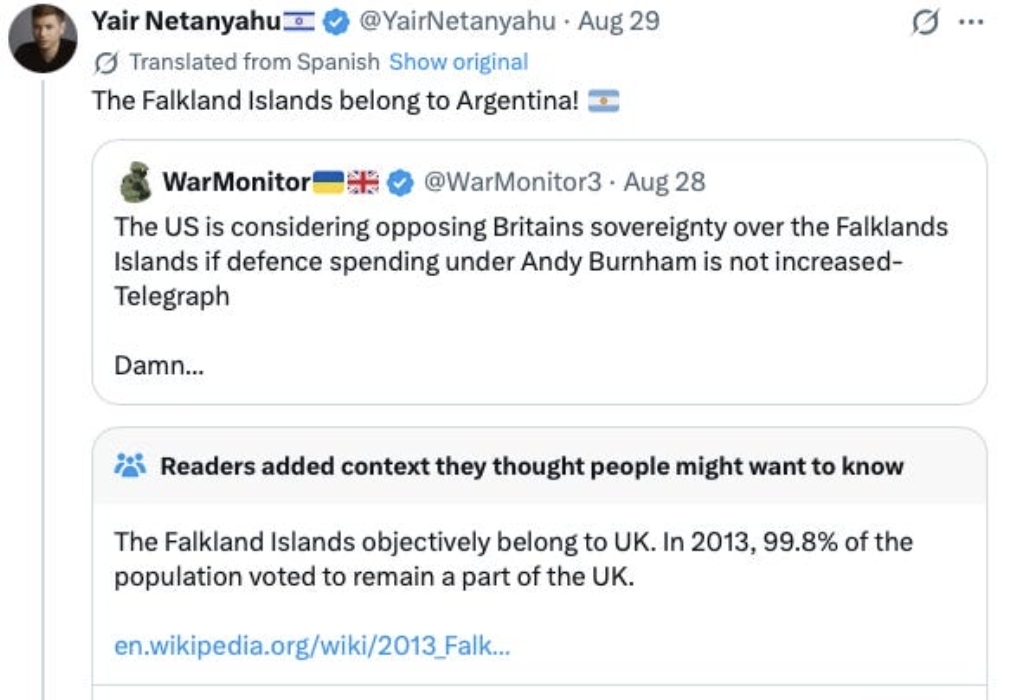
Neither development establishes that Israel has formally recognised Argentine sovereignty. Yair Netanyahu does not speak for the Israeli government, while Danon’s diplomatic intervention stopped short of endorsing Argentina’s territorial claim.
But the controversy has exposed an uncomfortable question about the limits of political friendship between Britain and Israel.
What happens when the interests of two supposedly friendly countries diverge?
Rupert Lowe’s Intervention
Lowe responded to the reports with an unusually direct challenge to Britain’s relationship with Israel.
“Why should Britain be expected to defend Israel’s national interests if Israel’s leadership refuses to respect ours?” he asked.
He continued:
“Britain is not obliged to give any foreign government unconditional political or military support.”
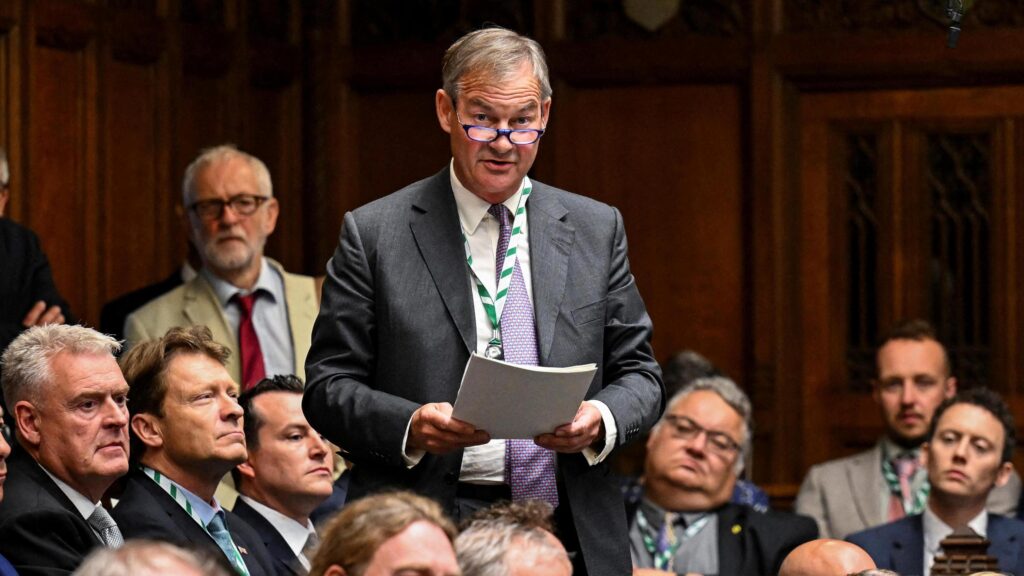
Lowe concluded by declaring that British foreign policy should be guided by British interests alone, describing that as Restore Britain’s position.
“The Falkland Islands are British, and will remain British.”
These are not inherently radical propositions. The idea that Britain should pursue its own national interests is hardly new.
What makes the intervention politically noteworthy is the context.
Much of the contemporary British right has defended Israel vigorously, particularly since the Hamas attacks of October 2023 and the subsequent war in Gaza.
Lowe’s comments therefore represent a potentially significant departure from the expectation that support for Israel should remain largely unaffected by disagreements over British interests.
Whether this becomes a lasting change in Restore Britain’s foreign policy remains to be seen.
The Friends of Israel Network
To understand the significance of Lowe’s intervention, it is worth examining the organisations operating within Britain’s established political parties.
Labour Friends of Israel describes its purpose as strengthening relations between Britain and Israel. Conservative Friends of Israel organises parliamentary delegations, briefings and engagement with Israeli political figures.
Liberal Democrat Friends of Israel similarly provides advice and information to parliamentarians, candidates and party members, while also advocating a two-state solution.
Reform UK has joined this landscape through Reform Friends of Israel.
These organisations are not identical. They differ in structure, affiliations, political outlook and policy priorities. Nor should their existence be confused with direct control of political parties by Israel’s government.
Nevertheless, they provide organised channels through which a particular foreign-policy relationship is promoted among British politicians.
Their influence is not purely theoretical.
An investigation published by Declassified UK in 2025 identified at least 56 trips to Israel funded for British politicians by pro-Israel organisations over approximately two years, with reported expenditure exceeding £133,000.
Such visits can be legitimate forms of parliamentary engagement. They can also create opportunities for access, relationship-building and advocacy.
The appropriate question is not whether politicians should be permitted to visit Israel or maintain relationships with Israeli representatives.
It is whether the public has sufficient transparency about the funding, access and influence associated with those relationships.
Is Restore Britain Different?
Restore Britain appears, at present, to occupy a different organisational position.
Unlike Labour, the Conservatives, Liberal Democrats and Reform UK, no equivalent Restore Britain Friends of Israel organisation could be identified in publicly available sources examined for this article.
That does not establish that Restore Britain is free from external influence. Nor does it demonstrate that Lowe’s position on Israel is necessarily more independent than those of other politicians.
Indeed, the absence of a particular lobbying organisation tells us little about a party’s donors, informal relationships or private diplomatic contacts.
But it does create a distinction worth investigating.
At a moment when other parties maintain established relationships with organisations devoted to strengthening British–Israeli ties, Lowe has publicly questioned the principle of unconditional support.
That raises questions about whether Restore Britain intends to adopt a fundamentally different approach to foreign policy, or whether its leader’s remarks are confined to the Falklands controversy.
The answer will depend on what the party does next.
The Falklands Are Not a Bargaining Chip
The Falkland Islands are not simply a convenient diplomatic instrument in disagreements between foreign governments.
They are home to a population whose right to self-determination remains central to Britain’s position.
In 2013, Falkland Islanders voted overwhelmingly to retain their status as a British Overseas Territory.
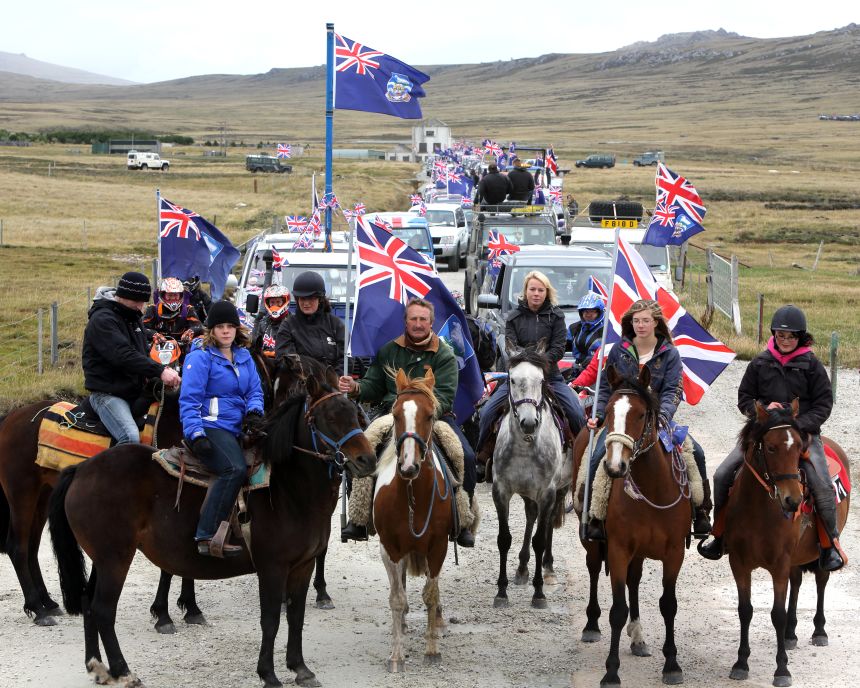
The British government has repeatedly maintained that there can be no negotiations over sovereignty without the consent of the islanders.
Any foreign government seeking to use the Falklands as leverage in an unrelated diplomatic dispute would therefore be challenging a principle Britain considers fundamental.
It would also raise questions about the reliability of diplomatic partnerships when relations deteriorate.
But there is an equally important distinction between a government making such a decision and politicians, commentators or relatives of government leaders expressing personal opinions.
The evidence must support the accusation.
Israel’s denial of the reported directive cannot simply be ignored because the original allegation is politically explosive.
British Interests Must Be Open to Debate
The controversy raises questions extending beyond Israel.
How should Britain respond when an allied government challenges its territorial interests?
Should foreign-policy partnerships be reconsidered when the interests of the countries involved diverge?
And what obligations of transparency should apply to organisations that seek to influence British parliamentarians on behalf of closer relationships with foreign states?
These questions should not depend on whether the country concerned is Israel, Argentina, the United States or any other nation.
Nor should scrutiny of Israel’s government become suspicion directed at British Jewish citizens. The actions of a foreign government are not the responsibility of a religious community living in Britain.
The distinction is essential to any credible discussion of foreign influence.
Rupert Lowe’s intervention has brought one part of that discussion into the open.
His criticism does not establish a change in Israeli policy, nor does it prove that Restore Britain has escaped the influences affecting other political parties.
But it does expose a tension that Britain’s political establishment may increasingly have to confront.
A diplomatic friendship is not the same as an unconditional obligation.
And when the sovereignty of British territory enters the argument, even longstanding political relationships can face questions they have previously avoided.
The Falklands dispute may yet prove to be a misunderstanding rather than a lasting diplomatic rupture.
But the questions it has raised about Britain’s political relationships, foreign-policy independence and the transparency of organised lobbying will remain long after the latest controversy has faded.








Leave a Reply